Designing for comprehension and trust at Hometap
As SVP of Design, I led the Self-Serve Estimate redesign, guiding UX, content, and research teams to deliver a data-driven, impactful solution for the business.
Business Context
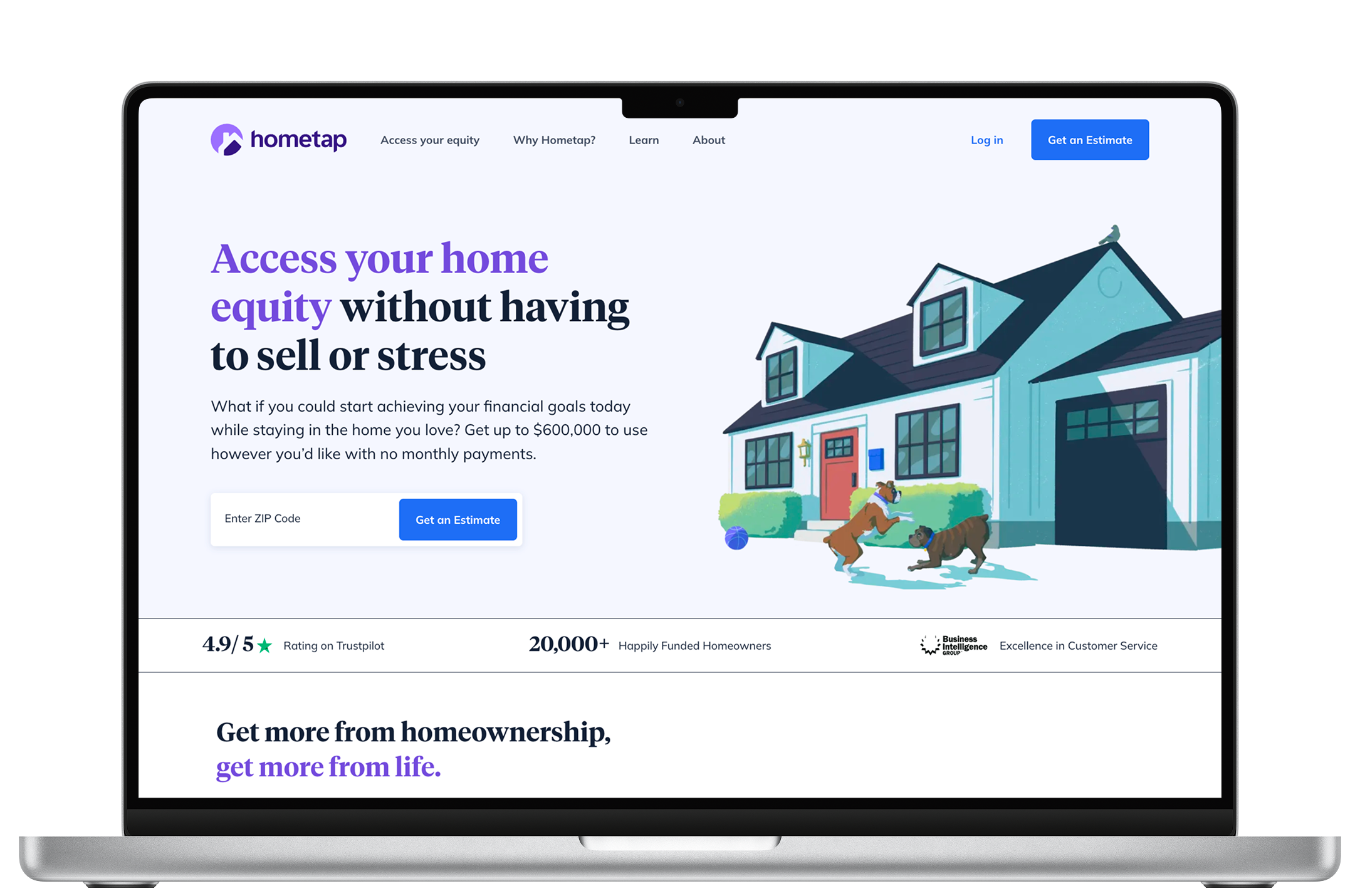
Hometap helps homeowners reach their financial goals by giving them access to their home equity without taking on debt or monthly payments. The design team’s goal is to empower homeowners to make informed financial decisions with confidence. To support this, our team has led a multi-pronged initiative to help homeowners better understand a complex financial product—a home equity investment (HEI). This work spans UX design, content strategy, and user research, all guided by a single north star: How might we help homeowners clearly understand Hometap’s product structure and pricing so they can decide if it’s right for them?
The Opportunity
Hometap offers a Home Equity Investment (HEI): homeowners receive a lump sum of cash in exchange for a share of their home’s future value, with no monthly payments. At settlement, they repay either the value of Hometap’s share or a capped maximum—whichever is lower.
Because this model differs fundamentally from a traditional loan, homeowner understanding is critical. Research and frontline observation surfaced consistent challenges: homeowners default to loan-based mental models, experience tunnel vision around getting to funding, and bring widely varying levels of financial literacy.
These gaps directly limited scale. Investment Managers spent significant time explaining pricing, while regulatory requirements demanded clear, consistent homeowner education. As a result, true self-serve adoption remained out of reach.
The strategic opportunity was to enable confident, self-serve decision-making. To support growth and capacity, homeowners needed to review an estimate and genuinely understand their investment—without one-on-one guidance—while still meeting regulatory and trust requirements.

The Foundation:
The Investment Estimate
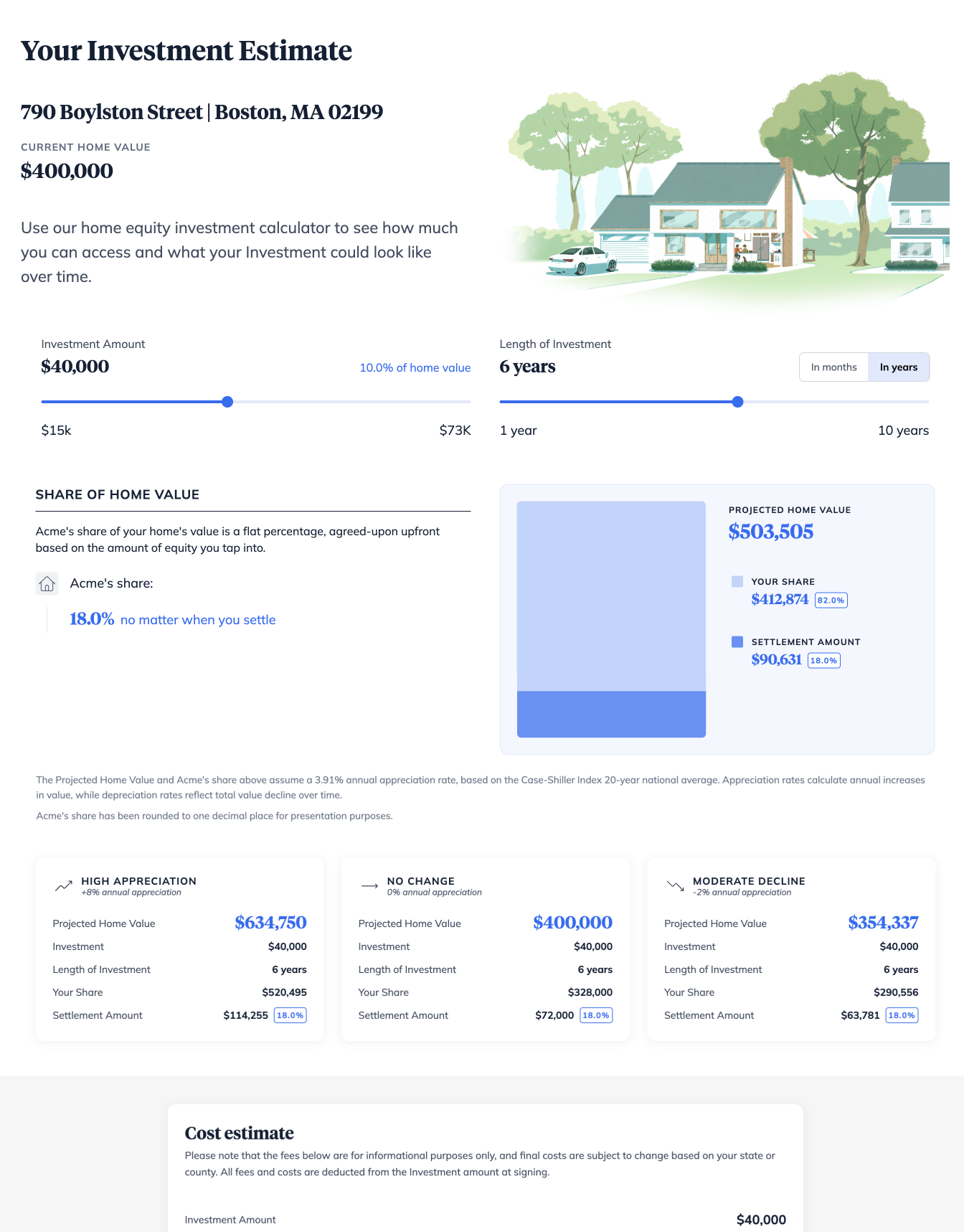
The cornerstone of homeowner education is the Investment Estimate, a personalized, interactive pricing tool translating HEI mechanics into concrete numbers. Homeowners can toggle between home price appreciation scenarios, investment amounts, and terms of up to 10 years to see how much they would owe.
While effective with a guided walkthrough, the tool wasn’t designed to stand alone. Our challenge: redesign it for a true self-serve experience while maintaining comprehension.
To measure success, we established a concrete benchmark: 80% correct on a Knowledge Check, evaluating two key capabilities:
Conceptual understanding: Can homeowners explain the HEI pricing structure, the Investment Cap and how settlement is determined?
Calculation accuracy: Can homeowners compute the correct settlement amount across scenarios?
Research & Prototyping
To test different design directions, the team built three prototypes using AI prototyping tools, allowing us to move quickly and handle actual calculations. We ran an unmoderated study with ~40 participants per group:
Concept A — Chart-based visualization: An interactive chart showing how settlement amounts change across scenarios.
Concept B — Natural language with scenario comparisons: Explanatory text paired with side-by-side scenario tables.
Concept C — Baseline: The existing estimate, enhanced with a tutorial feature to approximate a self-serve experience.
All participants first completed a shared educational flow before seeing any estimate. This sequencing was intentional: the team hypothesized—and the data confirmed—that front-loading concept education before presenting numbers improves comprehension. The flow covered HEI basics, how settlement works, and the Cap, ensuring homeowners understood core concepts before reviewing their personalized estimate.
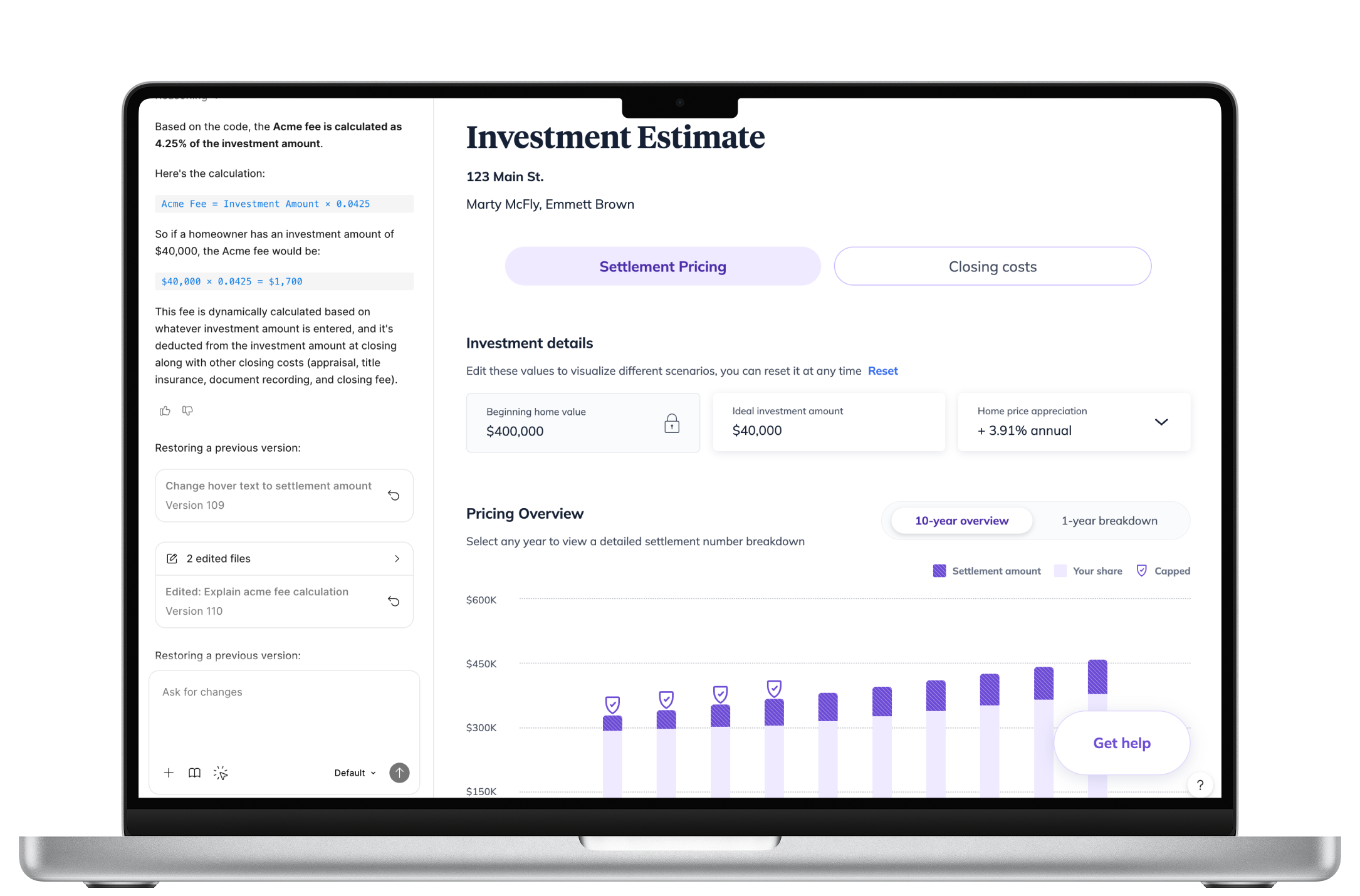
Figma Make prototype: Concept A
Results
The results were decisive. Concept A significantly outperformed the others, achieving 95% accuracy on the default scenario (average appreciation, settlement at Year 1)—the highest single-question score across all participants.
The baseline (Concept C) struggled across the board. Designed to accompany an Investment Manager walkthrough, it was not built to stand alone, so these results were expected—but they provided the business case to invest in a standalone, self-serve solution.
It’s important to note: Even with the stronger concepts, some gaps remained. Understanding of the Hometap Cap averaged only 60% accuracy across all groups, highlighting that the Cap itself—not just the estimate interface—requires further work to ensure clarity.
Key Lessons
The following principles helped build the business case for further investment into a standalone Estimate:
Positive sentiment ≠ comprehension. While homeowners and staff love our Estimate tool and find it easy to use, satisfaction alone doesn’t guarantee understanding. Open-ended calculation questions exposed gaps that confidence ratings missed.
Charts outperform text for financial math. For compounding, scenario-based pricing, interactive visualizations significantly improve accuracy compared with natural language explanations. (I’ll admit—this one surprised us, but that’s why you do the research!)
Education must come before numbers. Showing homeowners a personalized estimate before they understand the product structure sets comprehension up to fail. The educational flow is foundational, not cosmetic.
AI-enabled prototyping unlocks better research. Using AI tools allowed us to prototype real calculations—not just static screens—which made testing more realistic and insights more actionable than traditional manual prototypes.
Current Status and Next Steps
As of February 2026:
Concept A has been adopted as the foundation for the self-serve estimate and received cross-functional buy-in.
Research for Cap 2.0 messaging is underway, with finalized messaging expected by late February and a second round of naming/visual testing planned for early March.
The longer-term goal: a seamless homeowner experience where every homeowner can confidently answer: “What will I owe, and why?” Achieving this requires alignment between UX, compliance, and business performance—and with the design team’Hometap has made it a top priority.